
You're not imagining it. You're not losing the plot. And you are most certainly not alone.
Every woman's body tells this story differently. For some, it arrives quietly - a missed period here, a restless night there. For others, it sweeps in like an uninvited houseguest who rearranges all the furniture. However it shows up for you, menopause is one of the most significant transitions your body will ever go through - and it deserves to be understood, not feared.
In the UK alone, around 4.4 million women are currently between the ages of 45 and 54, the peak years for this change. Between 80% and 90% of them will experience symptoms, and a quarter will describe those symptoms as severe. Yet many women still reach this stage feeling completely unprepared - in fact, 60% only start looking for information once the symptoms have already begun.
So let's change that. Let's talk about what menopause actually feels like - the well-known bits and the surprises.
First Things First: What's Actually Happening?
Menopause is officially confirmed when you haven't had a period for twelve consecutive months. The average age in the UK is 51, though it commonly occurs anywhere between 45 and 55. But symptoms often begin years before your last period, during a stage called perimenopause - typically starting around age 47.
During this time, your oestrogen and progesterone levels begin to fluctuate and eventually decline. These hormones have been quietly running the show for decades - not just your reproductive system, but your brain, bones, skin, heart, gut, and even your ears. So when they start to shift, the effects can pop up in the most unexpected places.
The Symptoms Everyone Talks About
These are the ones most women have heard of, and for good reason - they're the most common:
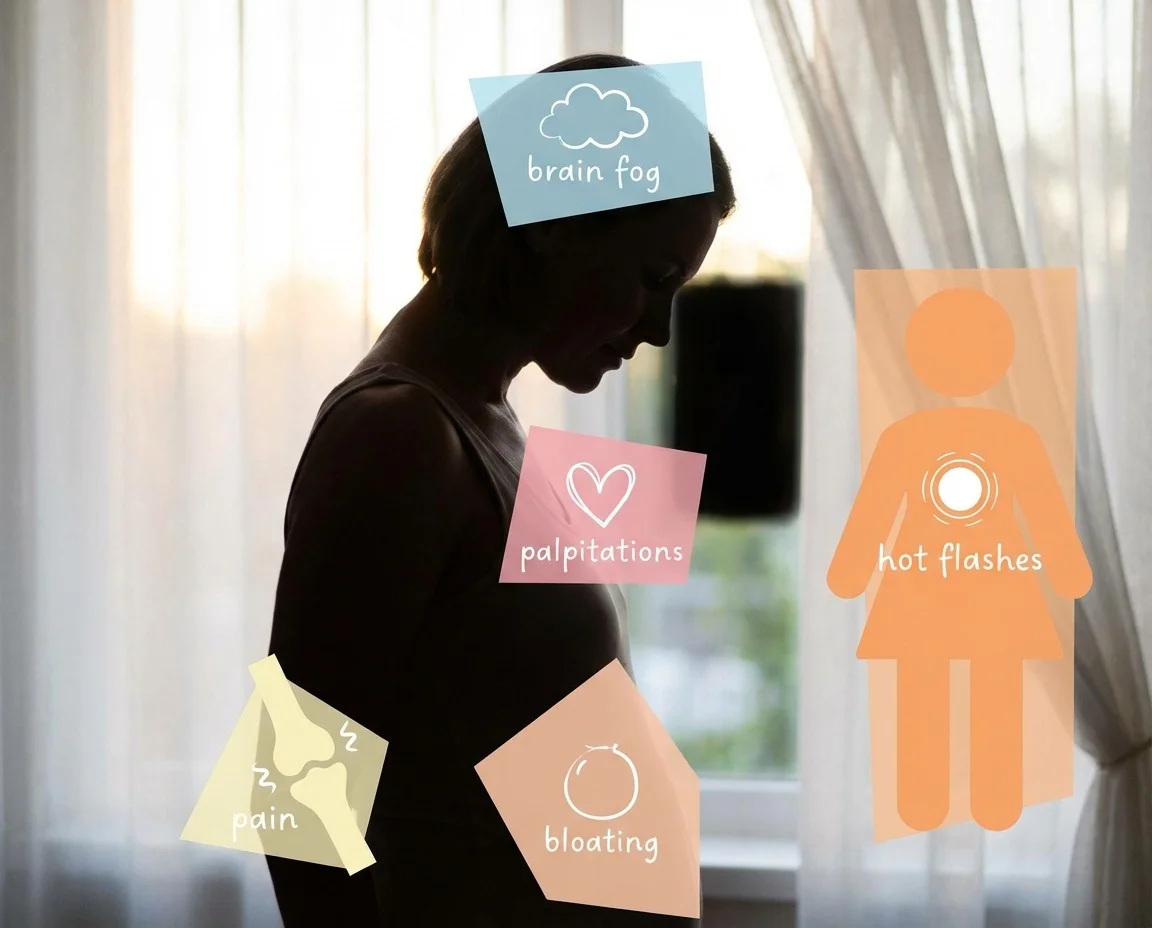
Hot flushes and night sweats - Sudden waves of heat spreading across your face, neck and chest. They affect 70–80% of women and can leave you drenched at 3am. Cold flushes can follow too - a sudden chill that catches you off guard.
Irregular periods - Your cycle may become unpredictable before stopping altogether. This is usually the very first sign of perimenopause.
Difficulty sleeping - Whether it's night sweats waking you up or your brain simply refusing to switch off, poor sleep affects more than 84% of menopausal women.
Mood changes - Low mood, anxiety, irritability, mood swings - these are not "just stress." Hormonal shifts directly affect your brain chemistry.
Brain fog - Forgetting names, losing your train of thought mid-sentence, walking into a room and having no idea why you're there. Around 73% of women report this.
The Symptoms Nobody Warned You About
Here's where it gets interesting - and where many women feel most confused, because these symptoms seem to come from nowhere:
Burning mouth - A strange tingling, burning or numbness on your tongue or inside your mouth. Around 40% of menopausal women experience this. It sounds peculiar, but it's a genuine hormonal effect.
Electric shocks and crawling skin - Tiny zaps under your skin, or the sensation that something is creeping across your arms or back. It's called paraesthesia, and it happens because nerve endings are sensitive to falling oestrogen.
Tinnitus and hearing changes - Ringing in the ears, or suddenly finding certain sounds unbearable. There are oestrogen receptors in your ear cells, and when levels drop, your hearing can be affected.
Dizziness and vertigo - Feeling unsteady, lightheaded or off-balance. This is linked to oestrogen's role in your inner ear and blood sugar regulation.
Digestive troubles - Bloating, increased sensitivity to certain foods, feeling like your stomach has a mind of its own. The gut is deeply sensitive to hormonal changes.
Changes in body odour - Increased sweating and shifts in your body's pH can alter how you smell. It's far more common than people admit.
Brittle nails - Your body may produce less keratin during menopause, leaving nails weak and prone to cracking.
Changes in spatial awareness - Feeling a bit clumsy? Bumping into door frames? Oestrogen decline can affect depth perception and concentration, making you slightly more accident-prone.
New allergies - Some women develop sensitivities they've never had before - to washing powder, perfume, or certain foods. This is thought to be connected to increased histamine production.
Voice changes - Hoarseness, vocal fatigue, or a shift in pitch. If you use your voice a lot for work, this one can be particularly noticeable.
Your Body Shape May Shift Too
It's not your imagination - and it's not because you've been eating more biscuits. On average, women gain about 1.5 kg per year during perimenopause, with a total average gain of around 10 kg by the end of the transition. As oestrogen drops, the body tends to store fat around the abdomen rather than the hips and thighs. At the same time, muscle mass naturally decreases, which slows your metabolism.
This isn't a moral failing. It's biology. Understanding it can help you respond with kindness towards yourself - and with practical steps like strength training, protein-rich meals and staying active in ways you enjoy.
The Emotional Side Deserves Equal Attention
Menopause doesn't just affect your body. 67% of women aged 40–60 report psychological symptoms, making it the most commonly reported category of menopausal effects. These include:
Anxiety that appears seemingly from nowhere
A deep loss of confidence - 52% of women say they've experienced this
Feeling unmotivated - reported by 61% of women
Low self-esteem and a sense of grief for the person you used to be
These feelings are valid. They are not weakness. They are your brain responding to a profound chemical shift - and help is available.
What Can You Actually Do About It?
The good news? You don't have to simply grit your teeth and wait for it to pass.

Speak to Your GP
Over half of women in the UK (55%) have discussed menopause with their GP, but that means nearly half haven't. You deserve professional support. If your first appointment doesn't feel helpful, you're absolutely entitled to ask for a follow-up or a referral.
Consider HRT
Hormone replacement therapy is the most effective treatment for menopausal symptoms. Around 2.6 million women in the UK are currently prescribed it, and 54% of those say it has given them their life back. There are different types - tablets, patches, gels, sprays - and your GP can help find what suits you. A government scheme now reduces the annual cost to under £20.
Lifestyle Adjustments That Genuinely Help
Keep a symptom diary - it helps you spot triggers (caffeine, alcohol and stress are common culprits)
Dress in layers you can peel off when a flush strikes
Prioritise regular movement - even gentle walking, swimming or yoga makes a real difference
A Mediterranean-style diet rich in vegetables, oily fish, nuts and good-quality protein has been shown to ease symptoms
Mindfulness and CBT (cognitive behavioural therapy) are recommended by NHS guidelines for managing anxiety and hot flushes
Lean on Your Community
You are one of millions. Online forums, local support groups, and workplace menopause networks are growing across the UK. In October 2025, NHS England announced that routine health checks for women will now include menopause questions for the first time - a significant step forward.
A Final Thought
Menopause is not an ending. It's not a decline. It is a transition - one that every woman on earth either has been through, is going through, or will go through. The fact that it's been whispered about for so long says nothing about you and everything about a culture that is only just learning to listen.
So if you're sitting here thinking "Is this normal?" - yes, in almost every case, it is. And if it's making your life harder than it should be, there is help. You don't need to be brave about this. You just need to be informed - and now you are.
Sources: NHS UK, Chemist4U Menopause Statistics Report 2025, Dr Louise Newson, HCA Healthcare UK, The Fawcett Society, CIPD, Ofcom Online Nation Report 2025.